Struggling with self-belief? It's time for a change
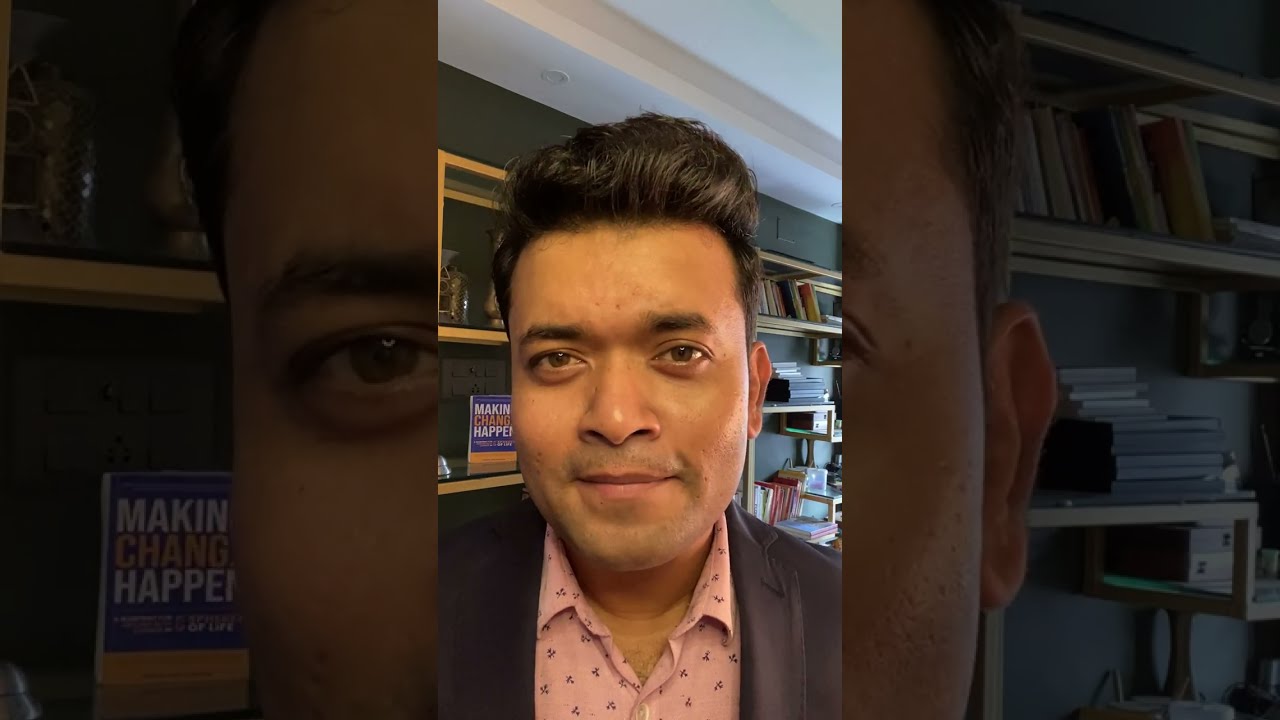
Most people think self-doubt is a fact about them. It isn’t. It’s a story they’ve rehearsed so many times it started to feel like a fact. That’s the quiet trap I wanted to open up in the video above — because once you see self-doubt as a learned position rather than a permanent identity, the whole thing becomes something you can work on. And working on it is the only honest path out.
I know the inside of this one well. A kid from a small town in the Northeast of India, raised mostly by my grandmother, who left for Chennai at sixteen to build an identity in a city where nobody knew his name. There was no map, no safety net, and plenty of nights where the loudest voice in my head was the one saying who do you think you are. Self-belief was not a gift I was handed. It was something I had to build, badly at first, and then a little better.
Self-doubt is a setting, not a sentence
The psychologist Carol Dweck spent decades at Stanford studying why some people crumble at the first failure while others treat it as information. Her conclusion, laid out in Mindset: The New Psychology of Success, splits us into two stances. A fixed mindset believes ability is carved in stone — you either have it or you don’t, so every setback is proof of your ceiling. A growth mindset believes ability is built — so a setback is just feedback on the current draft of you.
This is the hinge the whole video turns on. When you struggle with self-belief, you are almost always running fixed-mindset software: I’m not a confident person. I’m just not good at this. People like me don’t do things like that. Notice the grammar — it’s all permanent, all identity. The growth-mindset rewrite is small but seismic: add the word yet. I’m not good at this yet. That single word reopens a door the fixed mindset had welded shut.
Change is inevitable. Suffering is optional. And so is the story you keep telling about your own limits.
Why belief follows action, not the other way around
Here’s the part people get backwards, and it’s central to Making Change Happen. We wait to feel confident before we act. But belief is the macro output of hundreds of micro-actions taken on ordinary days. You don’t think your way into self-belief from the armchair — you assemble it, one kept promise to yourself at a time.
This is the effort-to-effortless spine of the book. Self-belief feels effortless in the people who have it, the way a building feels inevitable once it’s standing. What you don’t see is the decade of unglamorous foundations underneath. The confidence is the tower; the boring repeated effort is the engineering. There is no shortcut that skips the engineering — and the cruel flip side, what’s effortless to do is just as effortless to neglect, is exactly why most people’s belief erodes. They stop doing the small things, and the doubt rushes back into the vacuum.
So if you take one idea from the video, take this: stop trying to feel worthy and start acting in small ways that leave you proof. Evidence beats affirmation every single time.
Where this lives in the eight spheres
Self-belief isn’t a single problem you solve once. In the book it threads through several of the eight spheres — most obviously the Mental sphere, where loneliness, comparison and old trauma feed the doubt; and the Lifestyle sphere, where intentional design and rewiring limiting habits are how you starve it. Doubt also shows up wearing a costume in Business (calling it “being realistic”) and in Relationships (calling it “not wanting to be a burden”). Naming which sphere your doubt actually lives in is half the work, because a vague “I lack confidence” can’t be acted on — but “I freeze before I speak in meetings” can.
Something to do this week
Don’t wait for a transformation. Pick the smallest version:
- Find the sentence. Write down the exact self-doubt phrase you repeat. Then rewrite it with yet on the end and read both out loud. Feel the difference.
- Bank one piece of evidence a day. Do one small thing you’d normally avoid — send the message, ask the question, ship the rough draft — and log it. After a week you’ll have seven proofs instead of seven worries.
- Separate outside from inside. The way the book does it: write what others actually see (the visible symptom) next to what you actually feel (the root). The gap is usually enormous, and that gap is where the false story has been hiding.
If you want the trackers and frameworks I use for exactly this kind of rewiring, the free toolkits live at /gbr/, and the full blueprint — vulnerable parts and all — is in Making Change Happen.
Self-belief was never something I found. It was something I made, on ordinary days, long before I felt ready. You can start making yours today — and you don’t have to believe in it yet to begin.